The Landing Zone: Using an Oak Console Table to Solve Entryway Clutter

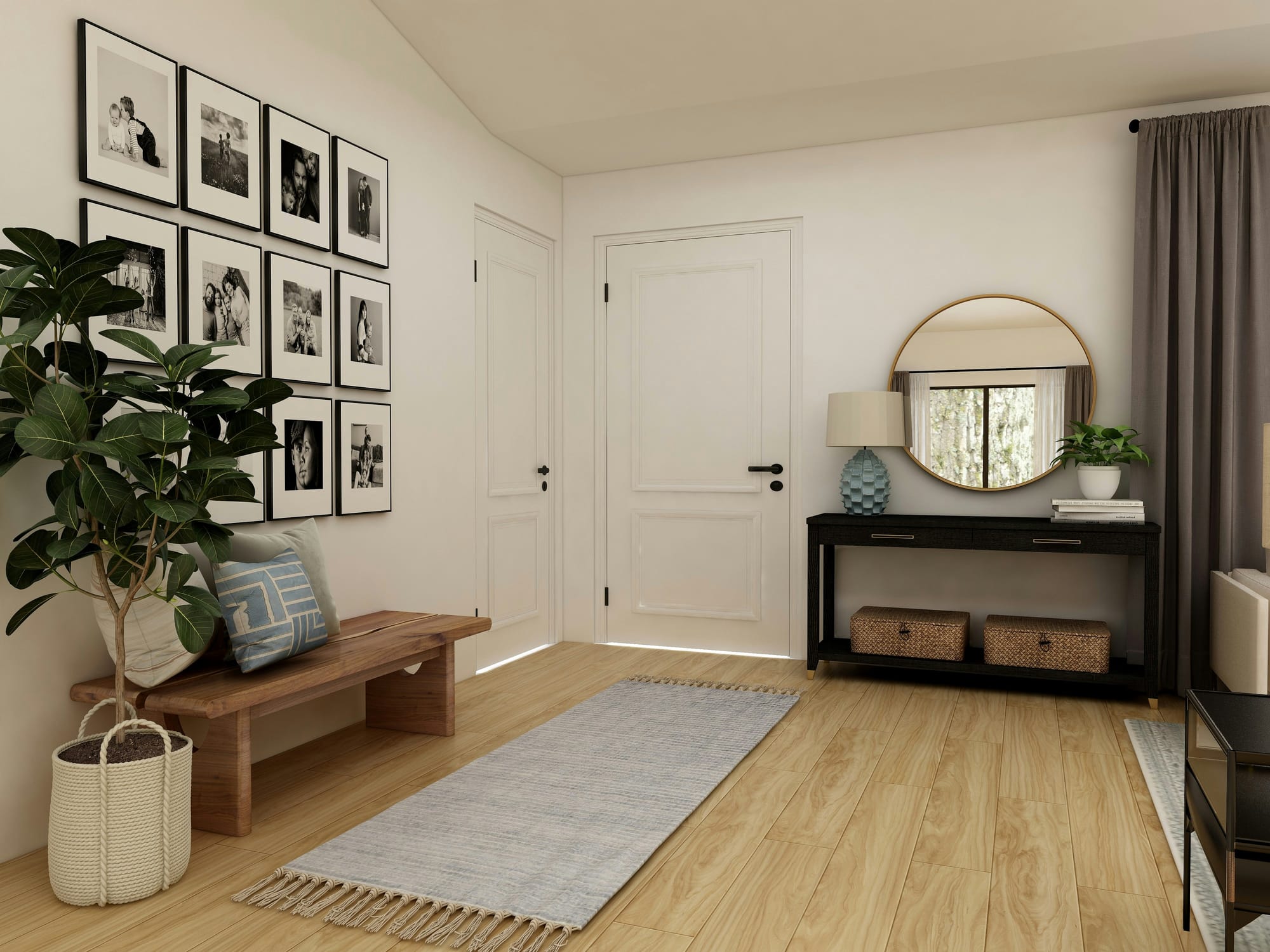
There is a particular spot in most British homes where order goes to die. It sits just inside the front door, roughly a metre in, and it collects everything: keys, unopened post, a lanyard, three sets of headphones, a dog lead, a parcel that needs returning, and at least one glove whose partner has vanished for good. You walk past it fifty times a week. You have almost certainly tidied it this month. It came back.
The instinct is to blame yourself, or the household, or the sheer volume of stuff modern life generates. But entryway clutter is rarely a discipline problem. It is a design problem, and specifically a problem of missing infrastructure. Items pile up by the door because they genuinely need to be near the door — and because nothing there has been built to hold them.
This is where the landing zone comes in: a single, deliberate surface positioned at the point of entry, designed to intercept the daily churn of objects moving in and out of the house. It is a simple idea with an awkward practical catch. Most UK hallways are narrow. Victorian terraces, 1930s semis and new-build corridors alike tend to offer somewhere between 90cm and 120cm of width, much of it swallowed by a front door swing and a staircase. A chest of drawers will not fit. A bench blocks the route. A sideboard turns a corridor into an obstacle course.
An oak console table solves the geometry. Shallow enough to leave a walkway clear, long enough to give you a genuine working surface, and solid enough to take years of keys being dropped on it from a height, it does the job that hallway furniture is actually asked to do.
Over the following sections we will look at why clutter gathers where it does, how to measure your hallway before you buy anything, how to divide the table into three distinct working tiers, and how to keep the whole system functioning once daily traffic starts to take its toll.
The Halfway House Problem: Why Your Hallway Collects Everything
Look closely at what actually accumulates by your front door and a pattern emerges. It is almost never rubbish, and almost never things that belong elsewhere in any obvious sense. It is keys. Post. Sunglasses. A work lanyard. The dog lead. A parcel awaiting collection. Sun cream in July, de-icer in January.
These are transitional objects — things caught in the gap between being in use and being put away. A set of car keys has no drawer in the kitchen. Yesterday's post is neither read nor binned. The dog lead will be needed again in six hours. Filing any of it properly would be a waste of effort, because all of it is coming back out shortly. So it lands on the nearest flat surface, which explains the specific, familiar geography of hallway mess: the radiator shelf holding a fan of envelopes, the third stair up doubling as an in-tray, the windowsill with a bowl of coins on it, the floor by the skirting where shoes gather like sediment.
The result is not one pile but several small ones, none of them intentional. And here lies the real cost. Distributed clutter is forgetful clutter. When keys can live in four different places, you spend real minutes each week finding them. When post is split between the stairs and the windowsill, something gets missed — a dental reminder, a parking notice, a card that needed replying to a fortnight ago.
One surface, chosen on purpose
A landing zone reverses the logic. Rather than resisting the habit of dropping things by the door, it gives that habit somewhere legitimate to go. All those scattered drop points consolidate into one designated surface, positioned exactly where the behaviour already happens.
The gain is not just tidiness — it is visibility. Clutter contained on a single surface announces itself. You can see, at a glance, that the post needs sorting or that four pairs of sunglasses have accumulated. Clutter spread thinly across a hallway blends into the architecture and quietly stays put for months.
Why 35cm is the magic number
So what should that surface be? The answer is dictated less by taste than by the dimensions of the average British hallway.
Depth is the deciding constraint. A surface of roughly 30cm to 40cm is deep enough to hold everything a household deposits on its way through the door — trays, lamps, post, a small plant — but too shallow to invite deep stacking. You cannot build a mountain on 35cm. The surface self-limits, which is precisely the point. Deeper furniture becomes a shelf for things nobody intends to deal with.
There is a spatial argument too. Hallway furniture must earn its footprint. In a corridor of 100cm, a chest of drawers at 45cm depth leaves barely enough room to pass, and a bench interrupts the route entirely. An oak console table, sitting flush against the wall at a fraction of that depth, gives you a full working surface while leaving the corridor navigable.
That combination — narrow profile, wall-facing orientation, generous length — is the console table's defining characteristic. It is furniture designed to occupy the edge of a room rather than the middle of it, which is exactly what a hallway landing zone demands.
Choosing one, however, means measuring rather than guessing.
Measure Twice, Unwrap Once: Surveying the Hallway Before You Buy
Furniture returns are miserable. Hallway furniture returns are worse, because you usually discover the problem when the delivery driver is already halfway down the path and the box will not go back through the door it just came in. It is the reason bulky purchases reward verification beforehand rather than correction afterwards — and the reason the tape measure comes out before the credit card.
Fifteen minutes with a tape measure prevents nearly all of it. Here is what to record.
The walkway you are left with
Start with the hallway width, wall to wall, measured at the narrowest point rather than the most convenient one. Subtract the depth of the table you are considering. What remains is your true circulation gap, and it needs to survive more than one adult walking through in a straight line.
Test it against reality: two people passing each other; a pushchair; the vacuum cleaner; a suitcase; the bin being wheeled out; a wardrobe box arriving. A 100cm hallway with a 35cm table leaves 65cm — walkable, though snug for two abreast. Drop to a 90cm hallway and the same table leaves 55cm, which functions for a couple but becomes tiresome in a house with children and a dog. If you are near the limit, look for models at the shallow end of the range, around 28cm to 30cm.
The things that do not move
Aesthetics lose every argument with fixed obstacles, and these are the measurements people take only after delivery.
Front door swing is the big one. Open your door fully and mark the arc on the floor — nothing may sit inside it. Then account for internal door architraves, the stair newel post, the meter cupboard, the alarm panel, the consumer unit, and the sloping underside of the stairs if that is where you had planned to tuck things. Understairs positions are especially deceptive: there may be ample floor space but insufficient headroom at the tapered end.
Two more worth checking. First, the delivery route — front door width, any turn into the hallway, and whether an assembled table can physically reach its spot. Second, whether the table blocks access to anything a meter reader or engineer needs to open.
Working out the vertical
Height coordination gets overlooked entirely, yet it determines whether the finished arrangement looks considered or accidental.
Most console tables sit between 75cm and 80cm — a comfortable standing height for dropping keys and sorting post. Check what that height collides with:
Skirting boards, which stop a table sitting truly flush and push the front edge forward by a couple of centimetres.
Dado rails, common in period properties, which may sit awkwardly close to the tabletop.
Radiators, particularly the height of the top edge relative to the table surface.
Light switches and sockets, which must stay reachable and unobstructed — a table pressed against a socket makes the plug unusable and the cable a hazard.
Then measure upwards. Wall space above the surface is prime territory for a mirror, a picture or coat hooks, but each needs breathing room. A mirror hung too low sits on top of a lamp; coat hooks positioned above the table mean coats brush the surface and knock things off it. Leave at least 20cm of clear wall between the tabletop and whatever hangs above.
With those figures written down, matching an oak console table to your specific hallway becomes a filtering exercise rather than a gamble — you are shopping with constraints, which is far quicker than shopping with hope.
Now to make the thing actually work.
Three Tiers, Three Jobs: Zoning the Table From Top to Floor
A landing zone that has not been zoned is just a shelf with ambition. Buy the table, put nothing in place, and within a month you have moved the mess from the stairs to a nicer surface — which is progress of a sort, but not the win you paid for.
The fix is to treat the piece as three separate storage levels and give each one a defined job. Anything without a designated tier does not belong there.
The surface: contained, not clear
Perfectionists aim for an empty tabletop. It never lasts, because an empty surface is an open invitation. A better target is a controlled surface: two or three fixed objects that occupy space permanently and leave a clearly bounded landing area for everything else.
The boundary does the heavy lifting. A tray, a shallow dish or a small bowl gives keys, coins and cards a hard edge to sit within. Keys inside the tray read as tidy; the identical keys 10cm to the left read as clutter. Nothing has changed except the border.
Three items is a sensible ceiling. A lamp — genuinely useful in a dark hallway, and warmer than the overhead light on a February evening — plus a tray, plus one plant or a framed photograph. Add a fourth and a fifth and the surface loses its shape.
The drawer: triage, not burial
Drawers are where landing zones quietly fail. Left undefined, a hallway drawer becomes an amnesty bin: everything goes in, nothing comes out, and eighteen months later you find takeaway menus from a restaurant that has since closed.
The remedy is one category per drawer, decided before anything goes in:
Post awaiting action — bills to pay, forms to return, anything requiring a response.
Spare and infrequent keys — shed, window locks, bike lock, the neighbour's spare.
Small essentials — pens, charging cables, tape measure, torch.
Personal items in daily rotation — sunglasses, reading glasses, lip balm, hand cream.
Simple dividers or small boxes stop categories bleeding together. And the post drawer needs a rule attached to it: emptied weekly, without exception. A drawer of unopened correspondence is worse than a visible pile, because at least the pile nags at you.
The floor: bulk, weight and wet things
The space beneath handles what the upper tiers cannot — the largest, heaviest and dirtiest items in the hallway.
Shoes in daily rotation live here, ideally two or three pairs per person rather than the entire household collection. So do wellingtons, umbrellas, dog towels, reusable shopping bags and the sports kit that reappears every Saturday morning.
Baskets are what make this tier work. Woven or fabric baskets that slide out cleanly conceal contents while keeping them accessible, and they can be lifted and shaken out over a bin. Leaving one section basket-free gives you a wipeable floor area for genuinely wet footwear — useful, given how much of the British year involves arriving home damp. Do mop up standing water rather than leaving it to sit, though: an oiled timber surface is water-resistant rather than waterproof, and duration is what causes marks, not the presence of a puddle.
Buying for the tiers
Work backwards from these three jobs and configuration becomes straightforward.
Households drowning in paperwork and small items want two or three drawers. Those who mainly need footwear control are better served by a leggy design with generous floor clearance, or a model with a lower shelf. A plinth base looks handsome but eliminates the floor tier entirely — fine in an entrance hall with a separate shoe cupboard, frustrating in a terraced hallway where the console is the only storage available.
The specification of your oak console table should follow the tiers you actually need, not the styling in the photograph.
Traffic, Wear and Knowing When One Table Isn't Enough
So far the table has been a catcher — a surface that intercepts things arriving. But a hallway is a two-way threshold, and the most useful landing zones work in both directions.
Staging what leaves the house
Think about your worst mornings. The parcel you meant to return sat by the kettle. The library books stayed on the coffee table. The letter you needed to post was upstairs. Every one of those is an outbound item that was never staged.
Reserve a defined corner of the surface — the far end, away from the tray — purely for things leaving the house next. Parcels for return, library books, a signed permission slip, dry cleaning, an envelope for the postbox. The rule is simple: if it needs to go out tomorrow, it goes to that corner tonight.
This single habit changes the table's character. It stops being a passive collection point and becomes a checkpoint, governing both what enters and what leaves. It also removes an entire category of morning friction, which in a household running to a school and commute schedule is worth considerably more than it sounds.
Where the damage lands
Hallway furniture takes punishment that no other piece in the house endures. Keys are not placed on a hallway table; they are thrown at it. Wet umbrellas lean against the leg. Damp coat sleeves drag across the front edge. Drawers get yanked open with one hand while the other holds a phone and a coffee.
That wear concentrates in predictable places:
The front edge, where hands, sleeves and bags make constant contact.
Drawer fronts and handles, subject to daily grabbing.
The end nearest the door, which absorbs the most traffic and the most moisture.
The surface directly beneath where keys land.
Which is where the material choice quietly justifies itself. A tray protects against key damage almost entirely. A coaster or felt pad under a lamp base prevents ring marks. Keeping the table clear of the direct drip line from wet coats matters more than any polish. And the great advantage of solid timber is that when marks do appear — and they will — the surface can be cleaned back and refinished rather than written off. A well-chosen oak console table absorbs a decade of daily abuse and looks better for it, which is not a claim you can make about a printed finish.
When the system is simply full
Here is the honest part. Some hallways do not have a clutter problem that furniture can solve.
If the surface overflows every single day despite proper zoning, the diagnosis is capacity, not discipline. A household of five with two dogs, three school bags and a cycling habit generates more transitional volume than any 35cm-deep surface can hold. Expecting one table to absorb it is unrealistic.
The answer is offloading whole categories elsewhere:
Wall hooks or a rail for coats, bags and dog leads — vertical space costs nothing in floor area.
A dedicated shoe rack or cupboard for the overflow the floor tier cannot take.
A wall-mounted pocket or letter rack for post, freeing the drawer.
A key cabinet or hook board at eye level, removing keys from the surface completely.
Do that, and the console table stops being asked to do everything. It handles what genuinely suits it — small items, the outbound corner, the landing tray — and performs that narrow job reliably instead of failing at a broad one.
The Quiet Value of a Surface That Works
Entryway clutter is not a moral failing. It is what happens when a household's daily traffic meets a corridor with no infrastructure to receive it. Give those transitional objects a defined place to land and the mess stops regenerating — not because anyone became more disciplined, but because the design finally matches the behaviour.
Your next steps are unglamorous and quick. Take the tape measure to the hallway and record three numbers: narrowest width, available wall length, and clear height below any dado rail or radiator. Mark the front door's swing arc on the floor. Then decide which tiers you actually need — drawers if paperwork and small items dominate, floor clearance if footwear is the problem, both if you can accommodate the length. Buy to those constraints rather than to a photograph, and set up the tray, the drawer categories and the outbound corner on day one, before anything has a chance to settle in the wrong place.
The wider point is worth sitting with. We tend to treat hallways as circulation space, worth decorating but not really worth planning. Yet the front door is the busiest threshold in any home — crossed dozens of times daily, in a hurry, with full hands and half an eye on the clock. A well-specified oak console table gives that threshold the structure it has been missing: shallow enough to keep a narrow corridor passable, sturdy enough to shrug off years of thrown keys and wet umbrellas, and organised enough that the post gets opened and the parcel actually makes it to the post office.
Which raises a fair question for anyone who has stepped over the same drift of shoes for the past three winters. How much time have you spent tidying a hallway that was never designed to be tidy — and what would change if the surface did that work for you instead?